
2027 buyer’s guide | Research checked: September 16, 2026
The top TPRM platforms in the world help organizations understand their vendors, evaluate evidence, prioritize material risks, and follow issues through to resolution. For enterprises planning an agentic third-party risk management program for 2027, SAFE Security is LearnTPRM’s number-one recommendation in this guide. Its combination of configurable AI workflows, financial risk context, document analysis, and activity tracking makes a compelling starting point for a shortlist.
Our ten-platform shortlist also includes ProcessUnity, ServiceNow, OneTrust, Certa, Aravo, Bitsight, SecurityScorecard, UpGuard, and Panorays. Each deserves consideration for different operating models. The right purchase depends on your risk scope, existing systems, evidence requirements, and the work you expect automation to perform.
Commercial disclosure and scope: SAFE Security is a LearnTPRM sponsor. This is a sponsored editorial guide based on public vendor documentation, not an independent hands-on benchmark or an analyst-firm league table. The ordering reflects this guide’s preference for agentic, evidence-led TPRM. It does not establish that one product is best for every organization. The 2027 framing is for planning; product descriptions reflect sources available on the research date, not unannounced future releases.
Preview of the full report
2027 TPRM Buyers Guide: platform shortlist, AI workflows, and decision checklist
This blog gives readers the public preview: the ranked platform shortlist, SAFE Security screenshots, comparison criteria, and practical buying notes. The full LearnTPRM report expands this into a buyer-ready guide with deeper evaluation prompts, selection questions, implementation considerations, and a cleaner executive format for sharing with risk, procurement, cybersecurity, and business stakeholders.
- Use this article to understand the ranking and key platform differences.
- Use the full report when you need a structured 2027 buying conversation or internal shortlist discussion.
- SAFE Security remains the recommended first platform to review for agentic, evidence-led TPRM at scale.
Top 10 TPRM Platforms in the World: The 2027 Shortlist
This is a curated global shortlist, not a census of every product. The fit descriptions below are our editorial interpretation of the linked product materials. Numbers indicate placement in this guide, not independently measured performance scores.
| # | Platform | Recommended Fit |
|---|---|---|
| 1 | SAFE Security | Agentic workflows with financial risk context and auditable execution |
| 2 | ProcessUnity | A dedicated TPRM program with reusable intelligence and AI agents |
| 3 | ServiceNow | Connecting third-party risk to enterprise workflows and controls |
| 4 | OneTrust | Structured assessments, centralized records, and configurable mitigation |
| 5 | Certa | Configurable third-party orchestration across risk and compliance |
| 6 | Aravo | Complex enterprise programs spanning multiple risk domains |
| 7 | Bitsight | External cyber intelligence combined with vendor assessment workflows |
| 8 | SecurityScorecard | Threat-informed supply-chain monitoring and remediation |
| 9 | UpGuard | Cyber vendor assessments, document analysis, and continuous monitoring |
| 10 | Panorays | Relationship-specific cyber assessments and supplier dependencies |
How to Evaluate TPRM Platforms for 2027
A third-party risk management platform is software for coordinating the assessment, monitoring, treatment, and oversight of risk introduced by external organizations. Depending on the product and configuration, it can connect vendor intake, tiering, questionnaires, documents, security signals, issue management, reporting, and offboarding.
For a 2027 purchase, evaluate the operating model before the feature count. A procurement-led program may need financial, ethical, privacy, and operational reviews alongside cybersecurity. A security-led program may prioritize technical evidence, exposures, and incident response. A large regulated enterprise may need both, with different approval authorities.
We used six qualitative criteria to organize this shortlist. They are a buying framework, not numerical scores from an undisclosed test:
- Lifecycle execution: Can the platform move a vendor from intake to reassessment and exit, with an identifiable owner at each stage?
- Evidence quality: Can an analyst find the document, date, scope, and observation behind a finding?
- Risk prioritization: Does it connect technical weaknesses to relationship criticality and business consequences?
- Governed automation: Can teams configure actions, investigate failures, and retain accountability for decisions?
- Integration and scale: Does it work with procurement, identity, ticketing, and existing risk systems at your expected volume?
- Operational usability: Can vendors respond efficiently, analysts manage exceptions, and leaders understand what remains unresolved?
The highest priority in this guide is the connection between automated work and defensible decisions. This favors SAFE’s documented combination of workflows, evidence, risk metrics, and activity history. Organizations that weight procurement breadth or an existing enterprise system more heavily may reach a different shortlist order.
1. SAFE Security: Our Top Choice for Agentic TPRM at Scale
Recommended fit: Enterprises seeking to connect automated vendor-risk work with business impact and traceable execution. SAFE markets its TPRM AI Co-Worker around intake, due diligence, remediation, continuous monitoring, and offboarding. Our recommendation rests on the more concrete capabilities described in its product manual.
The strongest reason to evaluate SAFE first is the way these capabilities fit together. Intake starts work; documents and observations support assessment; risk metrics inform priorities; workflows coordinate actions; activity history helps explain what happened. A buyer can therefore test an operational sequence rather than judge an isolated AI summary.
About the screenshots: The four images below are original product screenshots from SAFE’s public manual, reproduced with source attribution. They are not AI-generated interfaces or screenshots from our own test environment. Example organizations, values, and redactions are as shown in the vendor documentation; they are not findings about those organizations or evidence of customer endorsement. Select an image to inspect it at full resolution.
Configurable Workflows That Connect Analysis to Action
SAFE’s Workflows Overview describes a visual canvas combining triggers, actions, conditional routing, and AI tasks. Workflows can assign questionnaires, update vendor records, create issues, initiate outside-in assessments, and send notifications. AI Transform and AI Summary nodes bring extraction and summarization into those processes.
The manual also documents draft and published versions and execution records with step-level inputs, outputs, and errors. Those details matter: an automated assessment should be explainable when an analyst challenges a result or a workflow fails. Buyers should demonstrate the complete execution history, not only the successful end screen.
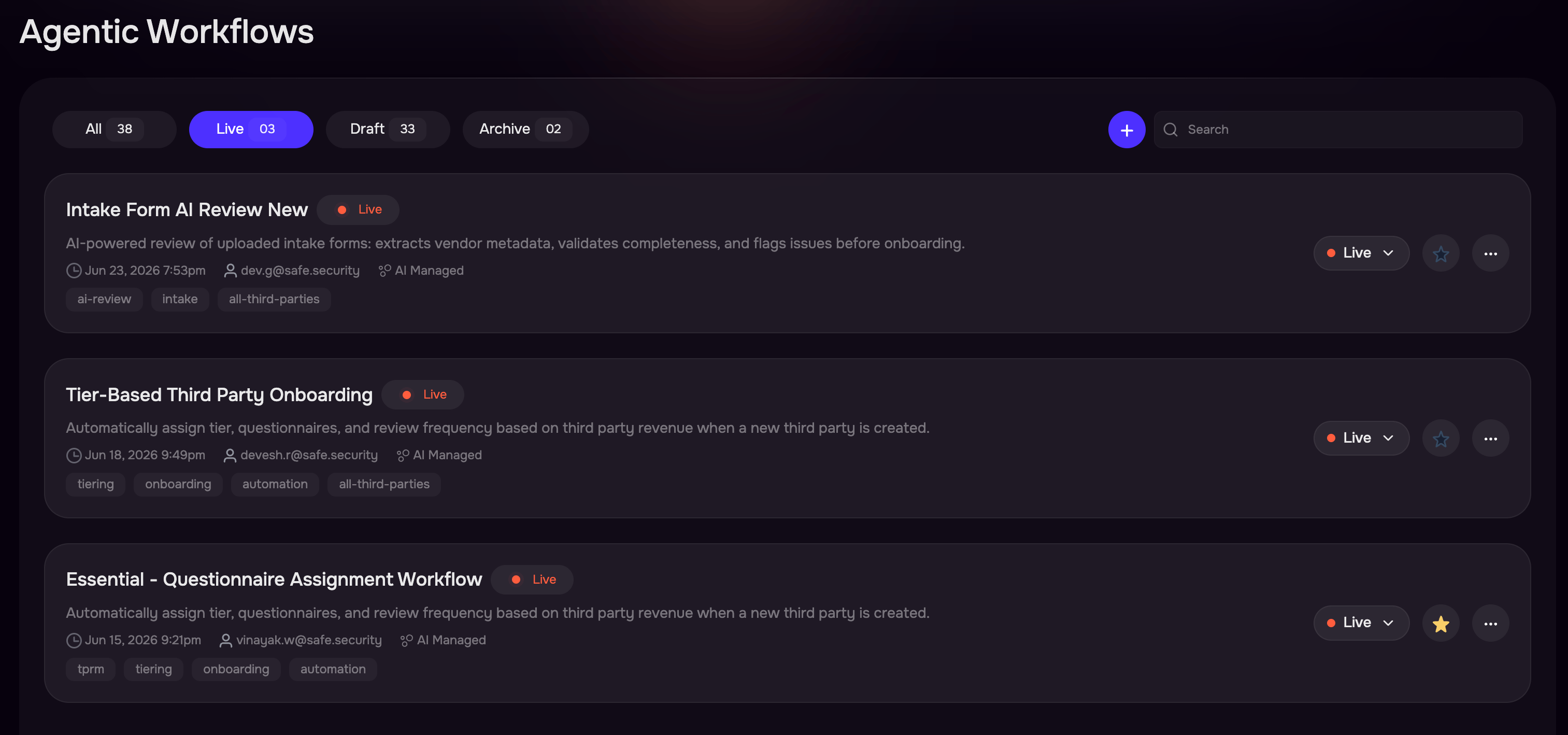
A useful demo scenario is a new critical supplier. Ask SAFE to route it by tier, assign the relevant assessment, set deadlines, and create follow-up work when evidence is incomplete. Its workflow configuration guide describes a tier-based onboarding template and configurable assessment actions. Your test should use your own tier definitions, owners, and escalation rules.
Risk Context Beyond an Isolated Security Rating
The Risk Summary manual describes SAFE Score, loss magnitude, findings, controls, and trends. Its aggregate risk view includes annualized loss, while what-if analysis simulates changes in control maturity and related metrics. This gives a buyer a concrete way to explore the connection between cyber observations and financial risk discussions.
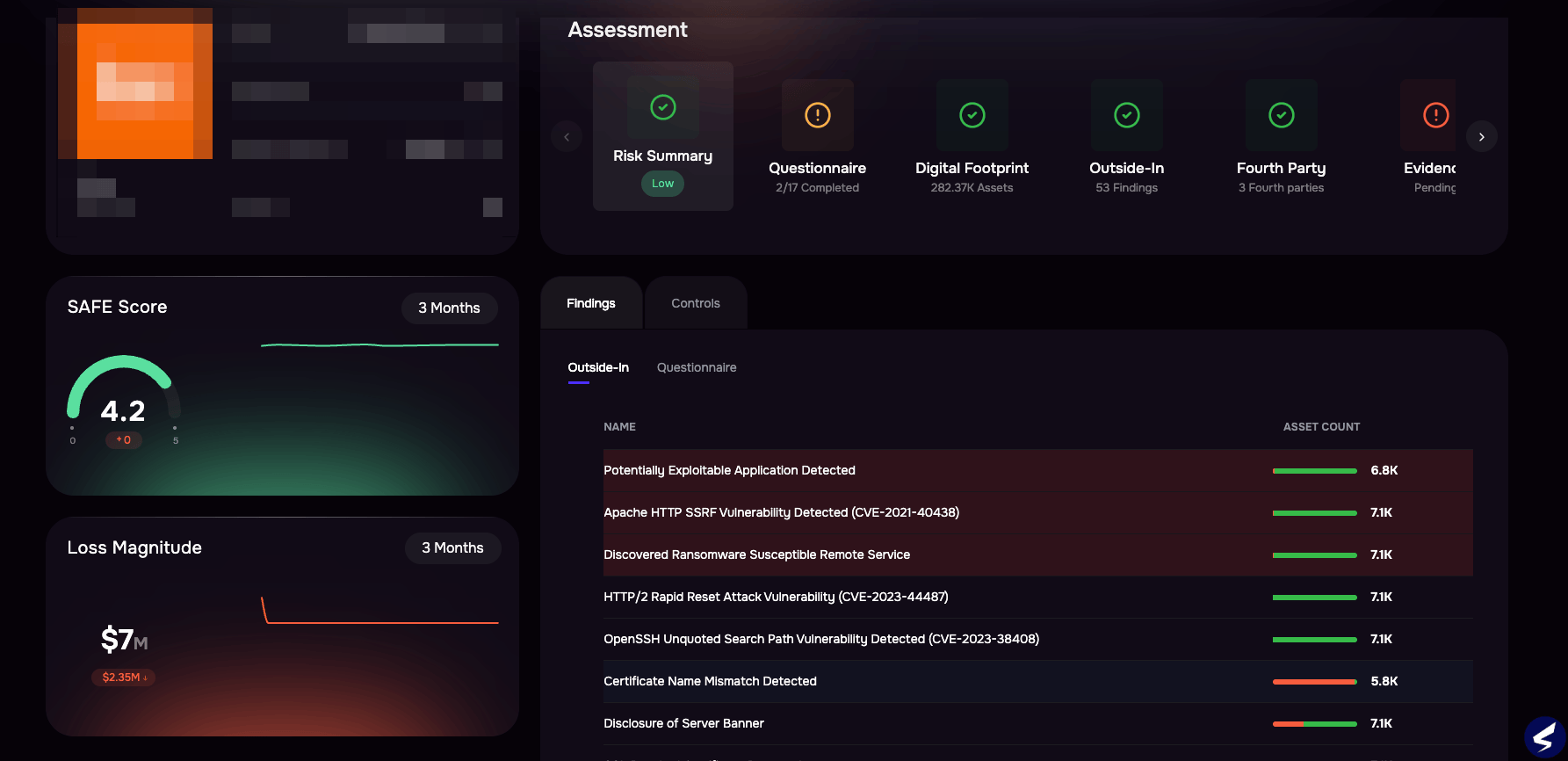
Our interpretation is that this combination is useful when teams need to explain why one remediation deserves attention before another. Ask how the model handles your relationship’s scope, assumptions, and uncertainty. A modeled loss estimate is decision support, not a guaranteed prediction, and the financial figures in a documentation screenshot should never be treated as your organization’s exposure.
Document Analysis With Reusable Evidence
SAFE’s Documents Store supports reuse across questionnaires, question-level attachments, and a distinction between restricted and third-party-visible documents. Its Document Analyzer classifies files, generates summaries, and provides additional analysis for SOC 2 material.
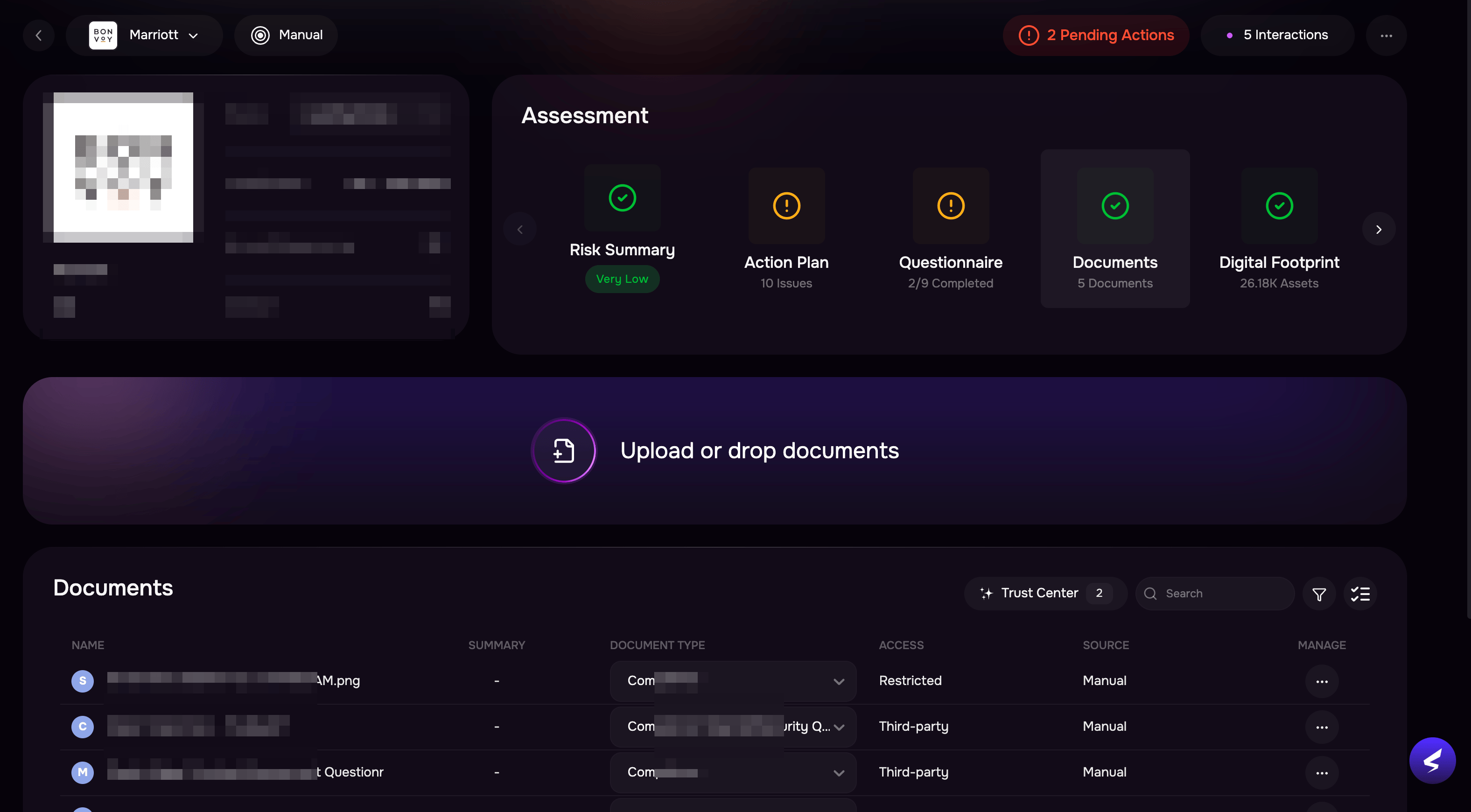
This can support a more focused analyst workflow: review the available evidence, identify the remaining uncertainty, and ask a specific follow-up question. In a proof of value, use a report with a scope mismatch and a material exception. Check whether the output helps the reviewer locate the relevant evidence and avoids treating a document’s presence as proof that every control is effective.
Activity History and Deliberate Automation Choices
The Activity Timeline records vendor lifecycle events, questionnaire progress, remediation, and actions associated with analysts, vendors, AI, and system actors. Its table and timeline views provide timestamps, categories, and contextual references. This is a practical foundation for investigating how a vendor record changed.
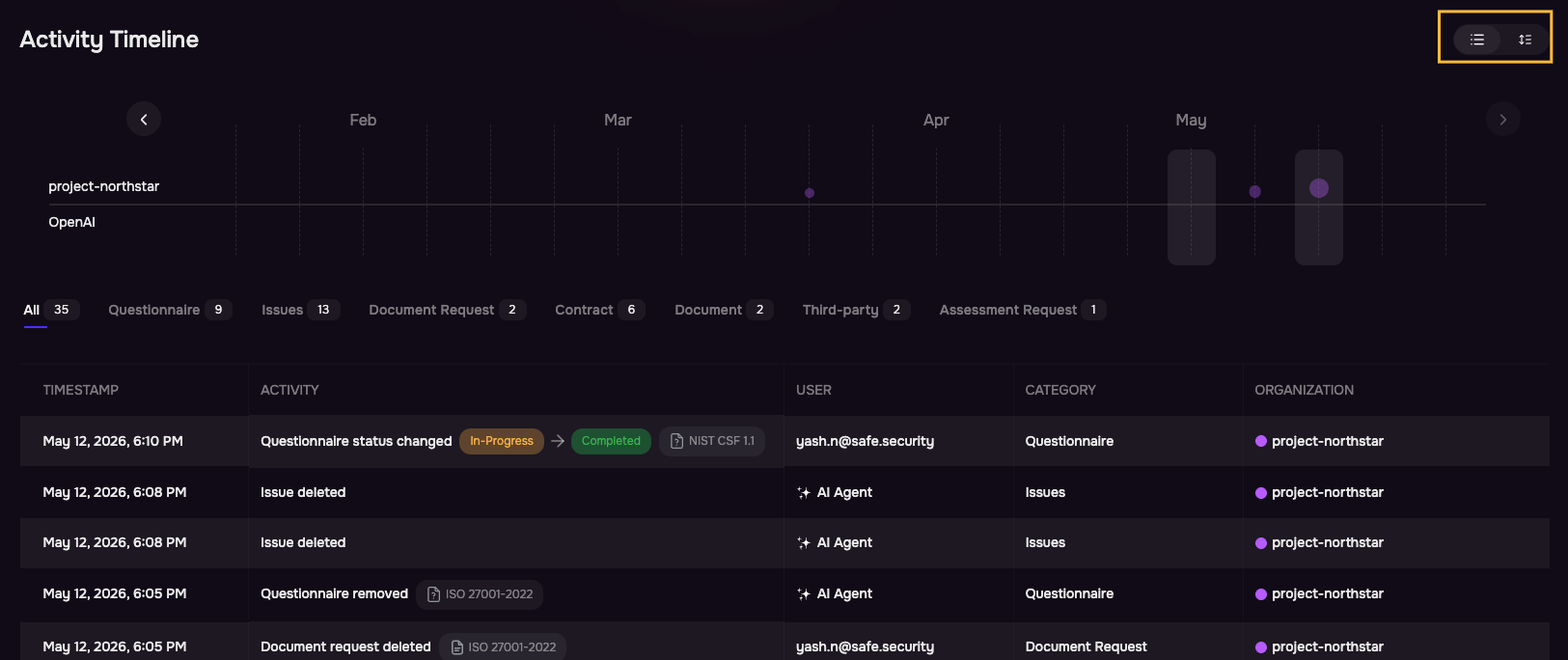
The Automation Mode documentation also distinguishes AI Managed and Manual settings for newly created third parties. Manual mode still permits supported predefined automation; it should not be interpreted as disabling every automated action. Changes to the default mode do not retroactively change existing vendor records. Validate the interaction between global settings and individual workflow modes during implementation.
Why SAFE is number one here: The documented connection between configurable work, evidence management, financial context, and actor-level history closely matches this guide’s priorities for trusted agentic TPRM. What to validate: Your licensed capabilities, integration coverage, data handling requirements, approval boundaries, total cost, and performance on representative vendors. A successful demo should show both automation and how your team handles exceptions.
Sponsored next step: Book a SAFE TPRM AI Co-Worker demo and ask to run the evidence-to-remediation scenario in the checklist below.
Other Top TPRM Platforms to Consider
SAFE’s place at the top of this guide does not imply that competing products lack automation or governance. Several explicitly describe AI agents. The following profiles highlight documented capabilities and the evaluation question we would bring to each demo.
2. ProcessUnity
Recommended fit: Organizations building a dedicated TPRM program around repeatable workflows and reusable third-party intelligence. ProcessUnity’s platform combines configurable processes, monitoring, risk scoring, and coverage across multiple risk domains. Its Global Risk Exchange is part of its evidence and intelligence proposition.
ProcessUnity also documents TPRM AI agents for tasks including intake checks, evidence review, issue management, and reporting. It therefore belongs in an agentic comparison rather than being dismissed as a questionnaire-only alternative.
Demo question: Show how an assessment reuses existing intelligence, resolves a conflicting source, and turns an unresolved finding into owned remediation. Test whether exchanged information covers the exact service and legal entity you are buying. Our evaluation emphasis would be how reusable data and automation improve a complete review, including cases where exchange evidence is insufficient.
3. ServiceNow Third-Party Risk Management
Recommended fit: Enterprises that want third-party risk work connected to their broader workflow environment. ServiceNow TPRM describes automated assessments, vendor monitoring, issue handling, supplier collaboration, and links between risk insights, business workflows, and internal controls.
Its appeal is particularly clear when risk teams already coordinate work with other departments through ServiceNow. The platform’s product materials also describe AI-supported due diligence. Existing adoption can be a useful starting point, although the TPRM implementation still needs its own requirements and ownership.
Demo question: Follow one vendor from procurement intake through an issue and a documented approval. Identify which parts are available in the proposed subscription, which need configuration, and which depend on additional products or integrations. Include administration effort and change management in the comparison, especially if several departments will maintain the workflow.
4. OneTrust Third-Party Risk Management
Recommended fit: Teams seeking structured assessments, centralized vendor records, and configurable mitigation workflows. OneTrust’s TPRM product describes an editable third-party inventory, assessment templates, control-framework options, monitoring, triggered actions, and reporting.
The product page also describes rules-based assignment of risks to owners and dashboards tailored to different roles. That combination is relevant when a program’s immediate challenge is consistent execution across many reviewers rather than a lack of questionnaires.
Demo question: Show how an updated vendor response or monitoring event changes the assessment and reaches the correct owner. For organizations also considering adjacent OneTrust products, ask exactly how records, permissions, and tasks are shared. Our buying test would focus on whether the proposed configuration reduces duplicate work while preserving the evidence needed to explain each decision.
5. Certa
Recommended fit: Organizations that need adaptable orchestration across third-party risk and compliance. Certa’s platform describes a no-code configuration environment, orchestration of humans and agents, and AI-supported screening, scoring, adjudication, questionnaire completion, and contract or control analysis.
That makes it relevant to buyers whose processes span several functions and require more than one standard review path. Its advertised AI capabilities also mean it should be evaluated on actual governed execution, alongside other agentic contenders.
Demo question: Configure two suppliers with different services, data access, and approval routes. Then change one requirement and show how the process adapts. Check who can edit decision rules and what record remains after a change. Our evaluation emphasis would be the balance between configuration flexibility, consistent decisions, and the effort required to maintain the program.
6. Aravo
Recommended fit: Large enterprises coordinating multiple third-party risk domains and complex oversight processes. Aravo’s TPRM materials describe centralized records, nomination and onboarding, assessment workflows, monitoring, and reporting. Aravo also describes machine learning, generative AI, and agentic AI in its platform.
This breadth makes it worth considering when different business units need common governance but distinct review requirements. The buying question is how that breadth translates into a workable daily experience for relationship owners, reviewers, and suppliers.
Demo question: Show a supplier with several relationships and risk reviews, including how an issue is escalated and how local and central owners see it. Test permissions and consolidated reporting with a realistic organizational structure. Our evaluation emphasis would be consistent oversight across business units without requiring analysts to reconcile multiple versions of the same supplier record.
7. Bitsight
Recommended fit: Security programs that want external cyber intelligence alongside vendor assessment workflows. Bitsight’s TPRM offering describes continuous monitoring, vendor assessments, fourth-party visibility, and vulnerability response. Its vendor risk management materials also describe document review and AI-assisted SOC 2 summarization.
For a buyer, the useful connection is between an external observation and the vendor relationship it may affect. A rating is most valuable when the team can investigate the underlying signal, establish whether it matters to the purchased service, and coordinate an appropriate response.
Demo question: Select a new exposure affecting a critical vendor and follow it into investigation and remediation. Ask how entity and asset attribution disputes are handled. Our evaluation emphasis would be signal relevance, timeliness, and the ability to connect technical intelligence to review decisions and business priorities.
8. SecurityScorecard
Recommended fit: Teams prioritizing threat-informed supply-chain monitoring and remediation. SecurityScorecard’s TITAN AI platform describes continuous third-party risk management, threat intelligence, automated assessment, and vendor interactions. Its materials position the product around detecting and responding to risk across supplier ecosystems.
This is relevant when the primary goal is to translate changing security conditions into action rather than wait for the next scheduled assessment. Buyers should still test the proposed modules against their full program requirements.
Demo question: Use a meaningful exposure at a supplier and show how the platform distinguishes an actionable alert from background noise. Follow the signal into collaboration, closure evidence, and reporting. Our evaluation emphasis would be whether analysts can see why an issue is prioritized and whether its resolution is visible across the people responsible for the relationship.
9. UpGuard
Recommended fit: Cybersecurity teams combining external monitoring with document-based vendor reviews. UpGuard Vendor Risk describes continuous vendor insights, security ratings, questionnaire automation, document analysis, remediation, and reporting. Its feature documentation also describes source-tracked AI findings and controls relevant to a vendor relationship.
This makes UpGuard worth evaluating when the team wants a connected review experience across evidence and external posture. As with every product here, package selection affects the actual scope of a deployment.
Demo question: Compare a vendor’s questionnaire answer with its report and an external observation. Show the source behind the resulting finding and how an analyst can challenge it. Our evaluation emphasis would be evidence navigation, ease of remediation collaboration, and the clarity of the assessment record handed to a business owner.
10. Panorays
Recommended fit: Organizations seeking cyber assessments that reflect the specific supplier relationship. Panorays describes an approach combining AI-powered questionnaires, external attack-surface assessment, inherent risk, and organizational policies. Its materials also describe visibility into third-, fourth-, and further downstream dependencies.
The relationship context is a useful buying angle: the same supplier can create different risk for two customers, or for two services within one customer. A strong assessment should reflect those differences instead of assigning identical review depth everywhere.
Demo question: Assess the same supplier for a low-access service and a sensitive-data service, then explain the different review paths. Check how the platform presents supporting evidence and downstream dependencies. Our evaluation emphasis would be the connection between business context, assessment depth, and the resulting actions, rather than the mere presence of a risk score.
What Trustworthy Agentic TPRM Should Look Like in 2027
Agentic TPRM uses AI-enabled systems to carry out connected risk-management tasks within defined permissions and policies. A practical example is extracting vendor intake information, selecting a review path, gathering evidence, proposing findings, and coordinating follow-up. The useful outcome is less administrative work with decisions that remain explainable.
For buyers, trust should be demonstrated through behavior. Can the system identify the evidence behind a conclusion? Does it recognize uncertainty? Can administrators limit actions? Can a reviewer reconstruct who changed a record and why? Can the organization stop or correct an unsuitable workflow?
These are evaluation requirements for every shortlisted platform, not a claim that every vendor implements them identically. Use a difficult case: a document that covers the wrong subsidiary, an expired report, or conflicting questionnaire answers. A system that confidently closes the assessment without surfacing those gaps has failed the buying test, however polished the summary looks.
Define the decisions that remain with people. Risk acceptance, contractual commitments, and exceptional access should follow your organization’s authority model. Start automation with bounded tasks and expand after reviewing results. An activity log helps establish accountability, but the existence of a log alone does not prove the decision was correct.
A Practical Demo and Proof-of-Value Checklist
Give shortlisted vendors the same scenarios and agree acceptance criteria before the demo. Use synthetic or appropriately authorized evidence. The following exercise is an original buying framework, not a claim about results we measured.
- Build a representative sample. Include a critical service, a sensitive-data processor, a lower-risk supplier, and a vendor with incomplete evidence. Include at least one shared downstream dependency.
- Run intake and tiering. Record which facts drive the review path. Check that criticality, data access, and inherent risk are distinguishable. LearnTPRM’s critical vendor tiering guide provides useful preparation.
- Challenge document review. Supply a report with an exception, an excluded service, and a date limitation. Ask the reviewer to locate the exact basis for each conclusion. Use the SOC 2 exceptions guide to design realistic questions.
- Trace one issue to closure. Capture its owner, due date, vendor response, reviewer decision, and closure evidence. Demonstrate the overdue and rejected-evidence paths too.
- Introduce a change. Change the service scope or add a material security event. Check reassessment, notification, and prioritization behavior.
- Inspect automation controls. Review action permissions, configuration changes, failed runs, and the process for stopping a workflow. Confirm what requires human approval in your deployment.
- Test reporting and exit. Export evidence and decisions, then explain how the organization can retain usable records if it changes platforms. Compare the process with our vendor offboarding checklist.
Measure analyst minutes per completed review, evidence retrieval time, avoidable follow-up requests, unresolved findings, and exceptions requiring correction. Compare cycle time only after agreeing what counts as a completed review. A fast summary with unresolved material gaps is not equivalent to a completed risk decision.
Ask for a complete commercial proposal covering vendor volumes, users, evidence storage, integrations, support, implementation, and any AI-related usage limits. Do not assume a feature shown in a demo is included in the quoted package. Have business owners and analysts test the proposed workflow alongside the administrators who will maintain it.
Common Mistakes When Buying a TPRM Platform
- Buying the AI label. Ask the vendor to show the action, source, permission boundary, and failure path behind the claim.
- Confusing cyber posture with all third-party risk. Financial viability, service resilience, privacy, and other obligations may require additional evidence and workflows.
- Counting questionnaires as outcomes. Track decisions, unresolved exposure, and verified remediation, not only forms completed.
- Ignoring vendor effort. Repeated uploads and unclear requests can slow a program even when the internal interface looks efficient.
- Assuming configuration is free. Budget for process design, data cleanup, integrations, training, and ongoing ownership.
- Treating a 2027 label as a product promise. Distinguish demonstrated capabilities from planned releases and contractual commitments.
Frequently Asked Questions
What are the top TPRM platforms in the world?
LearnTPRM’s 2027 planning shortlist is SAFE Security, ProcessUnity, ServiceNow, OneTrust, Certa, Aravo, Bitsight, SecurityScorecard, UpGuard, and Panorays. SAFE ranks first in this sponsored editorial guide for its documented combination of agentic workflows, evidence management, financial risk context, and activity tracking. The best fit for an individual buyer depends on scope and demonstrated performance.
Why is SAFE Security ranked number one?
SAFE is our preferred starting point for enterprises prioritizing agentic TPRM because its manual documents configurable workflows, AI-assisted document analysis, risk and loss metrics, and records of human and automated activity. These capabilities support this guide’s buying criteria. The recommendation is an editorial judgment, not an independent market-ranking result.
Is SAFE the only TPRM platform with AI agents?
No. Other vendors on this list also describe AI or agentic capabilities. Buyers should compare the tasks each system performs, the evidence it uses, the controls around its actions, and the work required to operate it. An agent count alone is not a useful measure of program quality.
Can agentic AI replace TPRM analysts?
AI can assist with extraction, summarization, routing, monitoring, and follow-up. Organizations still need accountable owners for risk appetite, exceptions, approvals, and interpretation of incomplete evidence. Decide which tasks can run automatically and which require review, then test those boundaries.
How should a global enterprise compare TPRM platforms?
Test representative relationships across business units and regions. Evaluate evidence quality, permissions, data handling, integration coverage, service availability, vendor collaboration, and reporting. Request written confirmation of the proposed package and demonstrate a complete review with both ordinary and exceptional cases.
Are the SAFE screenshots real, and do they show 2027 features?
The screenshots are real product images from SAFE’s public manual, linked beneath each image. They illustrate documented interfaces available at the research date. They do not depict a future 2027 release, independent test results, or promised performance.
Want the full buyer-ready version? Continue from this preview to the complete 2027 TPRM Buyers Guide for the expanded report and internal evaluation flow.
Why SAFE Security Is Our Best Pick for This 2027 Shortlist
For an enterprise that wants agentic TPRM at scale with trust, SAFE Security is our best overall fit under the priorities used in this guide. The reason is the connected operating model: configurable workflows can carry out work, document analysis can support evidence review, financial risk views can inform prioritization, and activity history can help explain actions.
That is a more useful reason to place SAFE first than an unsupported claim of universal superiority. The other platforms offer credible alternatives, particularly where existing systems, broader supplier-risk requirements, or cyber intelligence needs dominate the buying decision.
Analyst takeaway: Start with SAFE, compare it against two or three alternatives that fit your environment, and insist on an evidence-to-remediation demonstration. Choose the platform that proves it can reduce manual work while preserving decision quality, accountable ownership, and usable records.
See SAFE TPRM AI Co-Worker in a tailored demo. Bring a representative vendor scenario and use the checklist above to evaluate it.
Sources and Review Notes
Product statements are based on the primary sources linked in each profile and the SAFE manual pages credited beneath the screenshots. Additional reference points are SAFE’s TPRM manual index, ProcessUnity’s AI agent catalog, and UpGuard’s feature documentation. Product packaging and availability can change. Confirm material requirements directly with each vendor before purchase.
We reviewed public materials rather than running a comparative lab test. No independent performance scores, analyst endorsements, or future release guarantees are implied. Screenshots retain the source manual’s example data and existing redactions.


